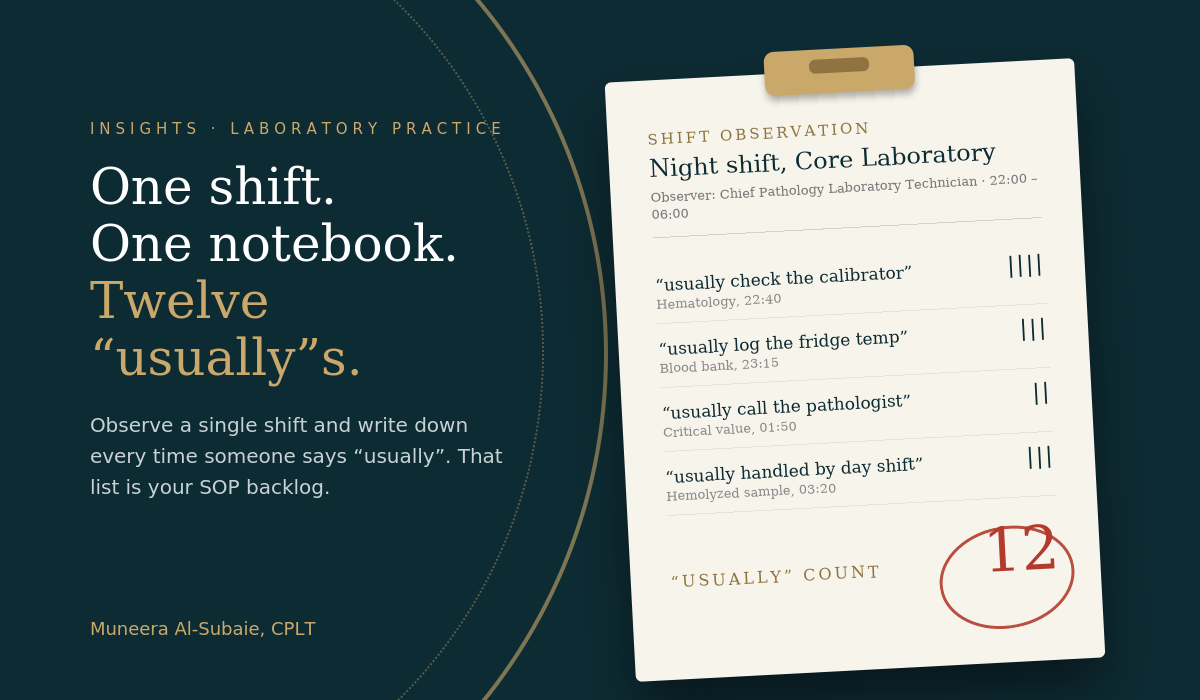
After 26 years of running laboratories, I learned to listen for one word: not “error” or “delay,” but “usually.”
“We usually check the calibrator before the run.”
“We usually record the fridge temperature.”
“The night shift usually knows when to call the pathologist.”
Each time I heard it, I knew where the next non-conformance would likely appear.
What “usually” actually means
“Usually” means the process relies on someone’s memory. It works when that person is on shift, alert, and not covering for someone else.
But it breaks down when a new technologist is alone at night, the analyzer flags an unfamiliar result, and the person who normally handles the issue is on leave.
Over time, “usually” can make staff accept informal habits without questioning whether those habits are reliable, documented, or safe.
Surveyors recognize this. When an ISO 15189 or CAP assessor asks, “Show me how you do that,” they are not questioning your staff’s competence.
They are asking whether the laboratory would remain competent if its most experienced technologist resigned tomorrow. A written procedure is the only credible answer.
Where “usually” hides
In most laboratories, “usually” shows up in three familiar places.
Handovers. Shift changes are where results can be missed. Conversations vary; forms create consistency.
Exceptions. Labs often document routine samples, but not hemolyzed samples at 2 a.m., missed critical-value calls, or analyzer failures. These gaps can put patients at risk.
Competency. Experience matters, but it is not proof. Surveyors need evidence that competency was assessed and documented.
Documentation is not bureaucracy
Documentation is not paperwork for its own sake. It keeps the right steps consistent, regardless of who is on shift. A good SOP is brief, practical, and written by someone who knows the work.
That is why I created the Monèra library. Every document started as a real laboratory “usually” that had to become a procedure before a survey. It is designed for laboratory professionals and easy to adapt.
Where to begin this week
This week, observe one shift with a notebook. Whenever someone says “usually,” write down what they mean. By the end, you will have a clear outline of the procedures your laboratory needs most.
Then write them or start with procedures that already exist!
Muneera Al-Subaie, CPLT, is the founder of Monèra Connect. She spent 26 years as a Chief Pathology Laboratory Technician across blood bank, hematology, histopathology, microbiology and quality management in the GCC.