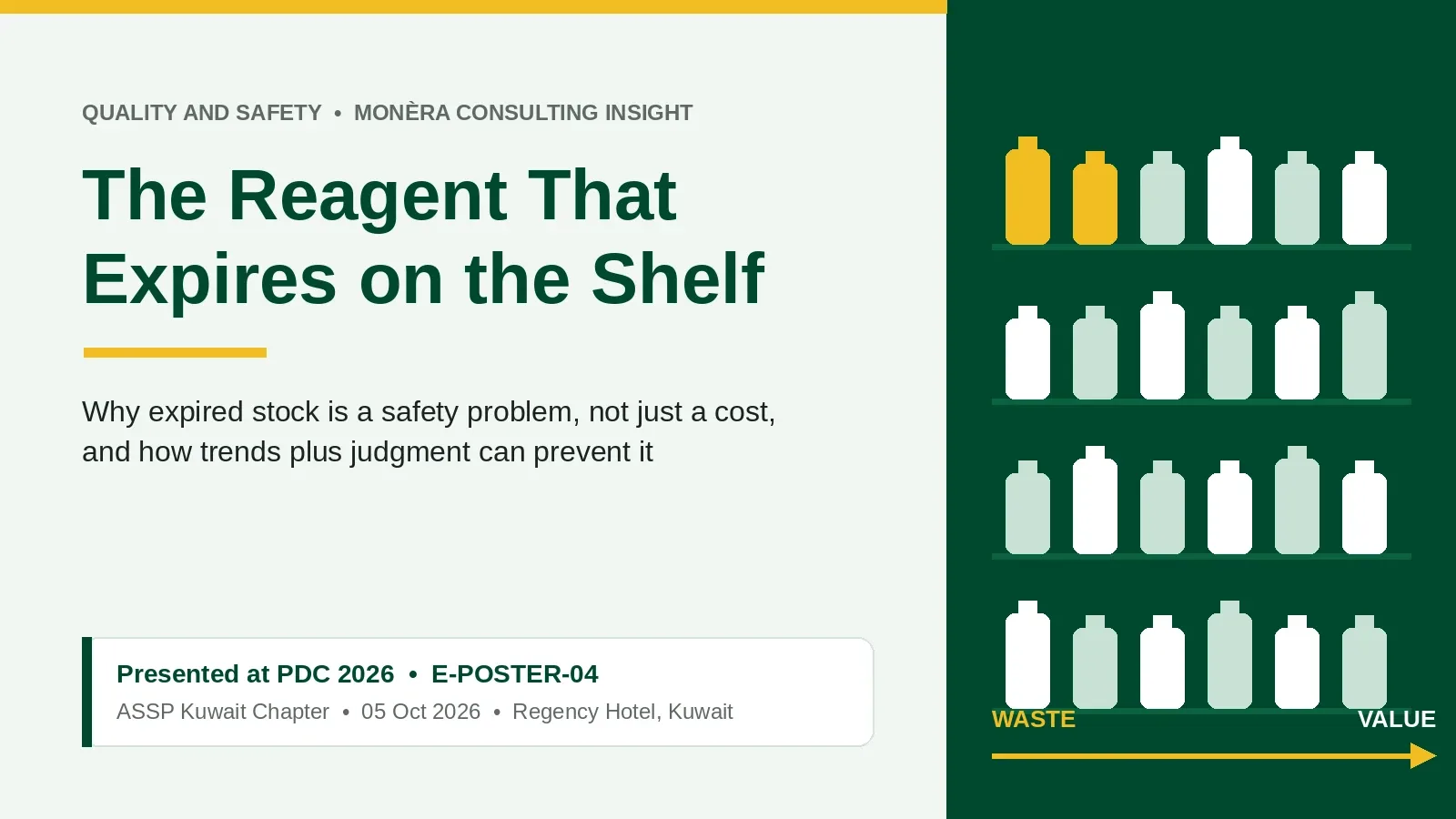
The Reagent That Expires on the Shelf
Why expired stock is a safety problem, not just a cost, and how trends plus judgment can prevent it
5 min read · Quality and Safety · Oct 7, 2026
Every laboratory manager knows the moment. You open the refrigerator and find a box of reagent that expired last week. It was never opened.
Most of us file that moment under "cost." After 26 years in laboratories, I file it under "risk."
Why expiry is a safety problem
An expired reagent does not simply disappear from the budget. It leaves a trail.
Patients. When stock sits too long, near-expiry material gets used under pressure. That is where quality control failures and doubtful results begin.
Environment. Expired reagents and chemicals become hazardous waste. Every box must be handled, transported and disposed of safely.
Staff. Overstocked fridges and storerooms mean clutter, heavy lifting and harder access in an emergency.
Service. Shelves full of the wrong items still leave you short of the right ones.
What we changed: Direct-to-Requisition
The habit behind most expiry is stocking "just in case." Bulk orders arrive with identical expiry dates, and short shelf lives do the rest.
Over four months, we replaced that habit with a risk-based Direct-to-Requisition (DTR) model. We reviewed real consumption and the expiry risk of every lot. We ordered to actual demand. We kept safe minimum levels for critical items. We asked suppliers for staggered deliveries and longer dates. And we monitored usage, delivery and expiry trends every month.
The principle is simple: the right material, in the right quantity, at the right time, without compromising patient care.
Numbers alone are not enough
Trend data told us what we consumed, which items moved slowly, and which lots were running out of time.
But the numbers could not tell us that a new test was about to start, that workload changes with the season, that an analyzer was due for maintenance, or that one supplier usually delivers late. Experience told us that.
When a lot approached expiry, we acted early. We used it first, moved it to where demand was higher, or held back the next order. Expiry was prevented before it happened, not discovered after.
Who it really protects
Behind every reagent is a patient waiting for a result. A leaner, well-governed inventory means the test is available, the result can be trusted, and money goes to care rather than the waste bin.
We saw less excess stock, less expiry-related disposal, better visibility of risk, closer coordination with suppliers, and no interruption to service.
Where to begin this week
Open your refrigerators with a notebook. Write down every item within 60 days of expiry and how much of it you used last month. By the end, you will know exactly where your laboratory's waste, and its risk, is hiding.
Then bring that list to your next order, not after it.
Presented at PDC 2026
This insight is based on my e-poster at the ASSP Kuwait Chapter's 13th International HSSE & Loss Prevention Professional Development Conference & Exhibition, held under the patronage of H.E. the Minister of Oil, State of Kuwait.
|
Session |
Detail |
|
Code |
E-POSTER-04 |
|
Date and time |
Monday, 05 October 2026, 11:45 – 12:05 |
|
Location |
Exhibition Open Technical Session Area, Regency Hotel, Kuwait |
|
Conference theme |
Intelligent HSSE: Leveraging AI to Strengthen Process Safety, Drive Sustainability and Enhance Operational Excellence |
Talk to us about inventory governance →
Muneera Al-Subaie, CPLT, is the founder of Monèra Connect and an HSSE Award winner (2019). She spent 26 years as a Chief Pathology Laboratory Technician across blood bank, hematology, histopathology, microbiology and quality management in the GCC. This insight is based on her e-poster at the ASSP Kuwait Chapter's PDC 2026 conference.